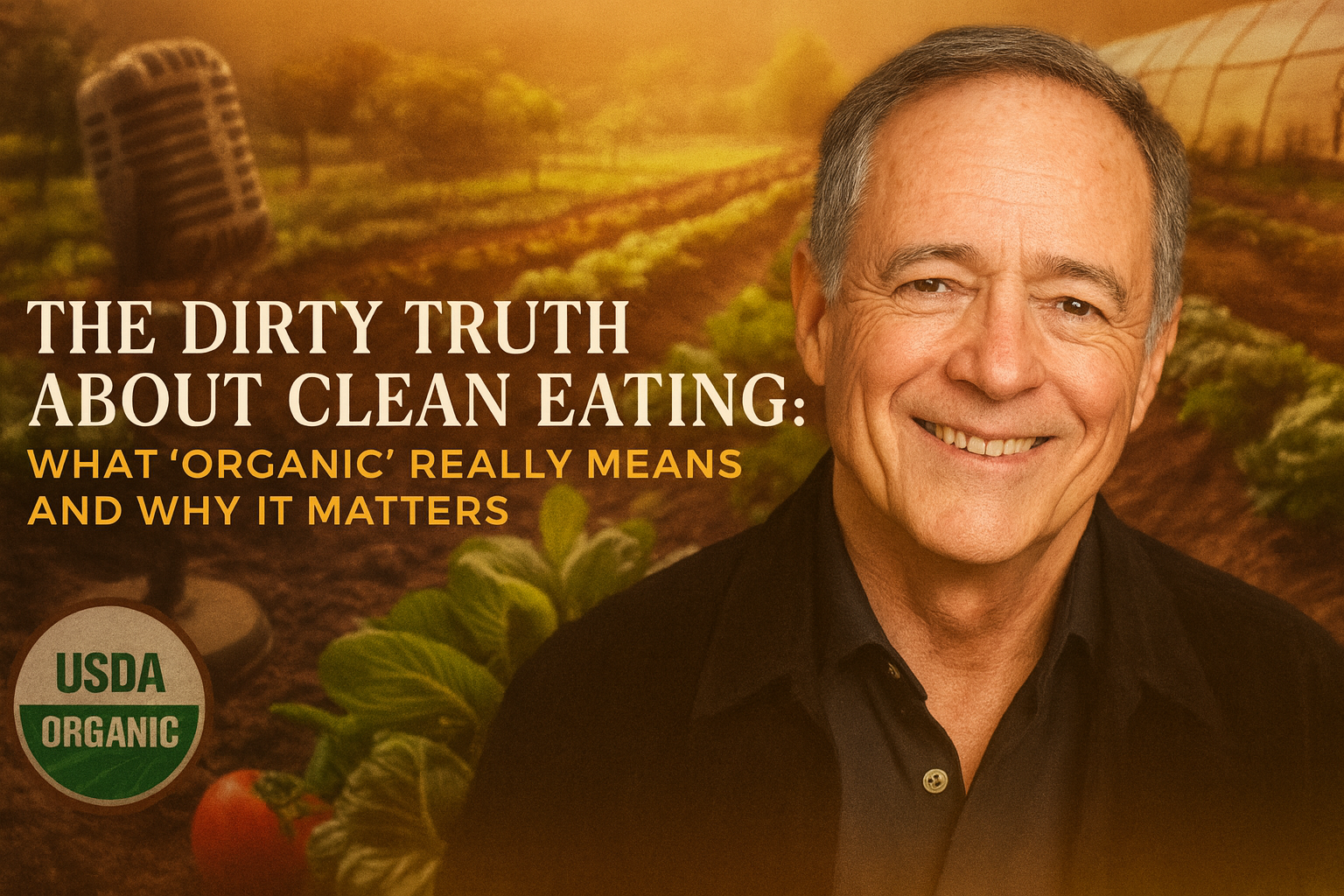
The Dirty Truth About Clean Eating: What ‘Organic’ Really Means and Why It Matters
What if the most radical act of self-care isn’t your next workout, juice cleanse, or meditation retreat — but what’s sitting on your plate?
We’ve been sold the idea that “healthy” means kale smoothies, supplements, and protein powders. But beneath all the marketing buzz, the real story of our health — and the planet’s — begins with the soil under our feet.
I recently had the pleasure of doing a podcast with Joseph Stern, one of the original pioneers of the organic food movement. Our conversation peeled back the label — literally — on what organic really means and why it matters. Joseph’s story is both inspiring and eye-opening, revealing how one man’s awareness of what was happening to our food supply helped shape a global movement.
Together, we explored how “organic” went from a fringe idea to a billion-dollar industry — and what it really means for your body, your wallet, and the earth.
1. Organic Beginnings: When One Garden Started a Movement
In the mid-1970s, Joseph Stern was just a twenty-something with a shovel and a vision. After spending six weeks at the Esalen Institute in Big Sur — where he worked in an organic garden modeled after the legendary Findhorn Garden in Scotland — he had an awakening.
“I realized that cancer rates were rising alongside pesticide use,” Joseph told me. “We were eating, bathing, and breathing those chemicals every day.”
Armed with that awareness, Joseph returned home to the suburbs of Philadelphia and started Earthly Organics with $5,000 in savings. He tilled virgin soil by hand, grew 50 different crops, and sold them to hospitals, universities, and even 7-Elevens — becoming one of the first organic distributors on the East Coast.
Back then, “organic” wasn’t even a legal term. There were no certifications, no standards — just a handful of idealists trying to grow food without poisoning themselves or the planet.
2. From Movement to Regulation: How “Organic” Got Its Definition
By the early ’90s, the demand for clean food had grown enough that Congress finally took notice. The California Food Act of 1993 required the USDA to create a formal definition of “organic” — and thus, the National Organic Program (NOP) was born.
The NOP became the law of the land, setting strict standards for how organic food is grown, handled, and labeled.
The basics:
No synthetic pesticides, herbicides, or GMOs.
No sewage sludge or irradiation.
A farm must follow organic methods for three years before certification.
Every player in the supply chain — from growers to warehouses to transport companies — is audited annually by certified third-party inspectors. Those agencies, in turn, are audited by the USDA.
In short: When you see that familiar USDA Organic seal, it’s not marketing — it’s law.
3. The Great Confusion: Organic vs. Non-GMO
Here’s where most shoppers get lost. You see a butterfly logo that says “Non-GMO” and assume it’s the same thing as organic. It’s not.
All organic food is non-GMO — but not all non-GMO food is organic.
“Non-GMO” only means the seeds weren’t genetically modified in a lab. Those crops can still be sprayed with toxic chemicals, herbicides, and fertilizers.
As Joseph explained, “Buying non-GMO is not enough. Buying organic automatically means non-GMO — it’s a much higher standard.”
Think of it this way: non-GMO is a label; organic is a lifestyle.
4. Taste the Difference: Why Organic Feeds More Than the Body
If you’ve ever bitten into a perfectly ripe organic tomato, you already know — the taste is different.
When crops are grown in healthy, living soil, they’re richer in nutrients and flavor.
“Healthy soil grows healthy food,” Joseph said. “And healthy food grows healthy people.”
Organic produce often has higher antioxidant levels and fewer pesticide residues. But the difference isn’t just chemical — it’s energetic. When soil is alive with biodiversity, the plants that grow there are vibrant, nutrient-dense, and yes, more delicious.
Real food tastes like the earth it came from — not the chemicals that forced it to grow faster.
5. The Price of Purity: Why Organic Costs More (and Why It’s Worth It)
We’ve all looked at that organic label and winced at the price. But here’s the truth: organic isn’t expensive — conventional food is artificially cheap.
Conventional farming cuts costs through shortcuts — chemical fertilizers, pesticides, and monocropping — but those “savings” come at a long-term cost to our health and the environment.
When farmers transition to organic, they endure a three-year period where yields drop and costs rise before the soil begins to heal. After that, yields often surpass conventional crops — but the market still demands a premium to recover early losses.
So yes, organic strawberries might cost more — but Joseph is clear:
“Strawberries are the most toxic fruit you can eat if they’re not organic.”
Think of organic as an investment — in your health now or your medical bills later.
6. Soil Is the New Superpower: Organic Farming and Climate Health
The conversation around food often stops at nutrition, but Joseph pushed it further.
“The biggest contributor to climate change isn’t just fossil fuels — it’s how we farm.”
Industrial farming relies on monocropping (planting the same crop repeatedly) and tilling (churning the soil each season), both of which destroy topsoil and release stored carbon into the atmosphere.
Healthy soil, on the other hand, acts like a carbon sponge — pulling carbon dioxide out of the air and storing it safely underground.
Organic and regenerative farming heal that soil, restore its carbon-absorbing power, and support biodiversity from microbes to pollinators.
So yes — that carton of organic berries might actually be fighting climate change.
7. Can We Trust Imported Organic Food?
It’s a fair question. When you see “Product of Chile” or “Made in Mexico,” how do you know it’s truly organic?
According to Joseph, imported organic food must meet the same standards as domestic crops.
“We have reciprocity agreements with countries around the world,” he explained. “Any foreign certification agencies must be accredited by the USDA.”
If it carries the USDA Organic logo, it’s held to the same standards — no matter where it’s grown. Many U.S. companies go even further, conducting additional testing for pesticide residue.
Bottom line: Trust the seal — not the rumor.
8. Conscious Eating: The Heart of Being Embodied
At Embodied, we talk a lot about movement, mindfulness, and mindset — but being embodied also means awareness in what we eat.
Conscious eating isn’t about restriction or guilt. It’s about connection — to your food, your body, and the planet that sustains both.
“You can pay a little more for your food now,” Joseph said, “or you’ll pay for it later in your health.”
Eating well isn’t just about nutrition — it’s about intention. Choosing organic isn’t elitist; it’s a vote for clean air, clean soil, and a future that values life over convenience.
Being embodied goes beyond the body — it’s about how we show up for ourselves, our community, and the earth.
9. The Future of Organic: From Trend to Truth
The organic movement isn’t slowing down. Sales have topped $60 billion in the U.S., and the price gap between conventional and organic foods is narrowing.
More consumers are paying attention to how their food is produced. Farmers are learning that regenerative methods — which heal soil instead of stripping it — yield stronger, more resilient crops.
The next frontier? Regenerative certification, a new standard that goes beyond sustainability into full ecological restoration.
The future of organic isn’t about eating perfectly — it’s about eating consciously.
10. The Conscious Plate: Awareness Is the Real Superfood
Organic food isn’t about being fancy or trendy — it’s about returning to integrity.
To care about what we eat is to care about ourselves, our families, and our planet.
So the next time you’re in the grocery store, take a pause. Read the label. Ask where your food came from. Every choice you make is a ripple in a much larger ecosystem — one that includes you.
When we eat consciously, we live consciously.
Being embodied is about awareness — the kind that transforms both your body and the world it inhabits.
Stay grounded. Stay curious. And keep drinking your green juice.
Listen to the Full Conversation
🎙️ Want to go deeper?
Listen to Episode 6 of Embodied with Kathy Covington,
“The Dirty Truth About Clean Eating — Conscious Choices in Eating with Joseph Stern.”
Available now on Spotify, Apple Podcasts, and wherever you listen.
Because being embodied goes beyond the body — it’s about how we live, eat, and awaken to what truly nourishes us.
