Leadership Stress and Aging: Why High Performance Is a Health Risk
Leadership stress doesn’t always show up as burnout or breakdown. More often, it looks like consistent high performance—until your body starts to send signals you can’t ignore.
If you’re constantly making decisions, managing teams, and holding responsibility, there’s a hidden cost: chronic stress that accelerates aging. This article breaks down how leadership stress affects your health, why traditional wellness strategies may not be enough, and what to do about it—based on both science and experience.
How Leadership Stress Shows Up Differently
Leadership stress is often misread because it looks like success. You’re functioning, producing, and even thriving on the surface.
But underneath, your nervous system is likely operating in a prolonged sympathetic (fight-or-flight) state.
Common Signs of Chronic Leadership Stress:
Persistent fatigue despite adequate sleep
Brain fog or difficulty focusing
Increased irritability or emotional reactivity
Frequent tension headaches or muscle stiffness
Digestive issues (bloating, constipation, food sensitivities)
Sleep disruption—trouble falling or staying asleep
The kicker? Many leaders normalize these symptoms, chalking them up to “just part of the job.” That normalization leads to long-term damage.
The Biology Behind Stress and Accelerated Aging
Stress isn’t just a feeling—it’s a full-body physiological response. Over time, unaddressed stress wears down your body’s ability to repair and regenerate.
What Happens in the Body:
Elevated Cortisol: High cortisol levels disrupt sleep, lower immunity, and break down muscle and collagen.
Inflammation: Chronic stress increases inflammation, which contributes to aging-related conditions like heart disease and cognitive decline.
Slower Cellular Repair: Stress affects telomere length—protective caps on chromosomes linked to aging and disease risk.
Hormonal Imbalance: Stress impacts thyroid and reproductive hormones, affecting energy, mood, and metabolism.
Bottom line: Even if you eat well and work out, your leadership lifestyle might still be aging you faster than necessary.
Why Traditional Wellness Advice Doesn’t Always Work for Leaders
The usual wellness tips—drink water, meditate, take breaks—are helpful but often unrealistic for people in high-stakes leadership roles. Why?
You’re always “on.” There's little time or space for full recovery.
You hold more than most. Decisions, outcomes, and people often rely on you.
You're a perfectionist. Letting go is harder when your identity is tied to performance.
What’s needed isn’t more surface-level hacks—it’s nervous system regulation, sustainable boundaries, and leadership redesign.
From Burnout to Balance: What I Learned Running a Wellness Brand
I learned this lesson the hard way.
When I launched a wellness brand, I assumed I was immune. I exercised, ate well, and meditated. But my biology told a different story—I was anxious, tired, and emotionally drained.
What Changed:
I stopped over-identifying with my productivity.
I built recovery time into my calendar like it was a board meeting.
I redefined strength—not as endurance, but as regulation.
Running a wellness brand taught me this: leadership doesn’t just live in your calendar—it lives in your body. And your body always keeps the score.
Leadership Stress Is a Health Issue—Not a Personality Flaw
Let’s reframe this.
You’re not weak. You’re not doing it wrong. You’re experiencing a biological response to prolonged, unmanaged responsibility.
The real question isn’t, “Can I handle this?” It’s, “What is this level of stress doing to my health long-term?”
When you treat stress as a medical issue—not just an emotional one—you create space for real prevention, not just survival.
Leadership, Cortisol, and the Anti-Aging Conversation
In the wellness world, we talk a lot about aging. But the truth is:
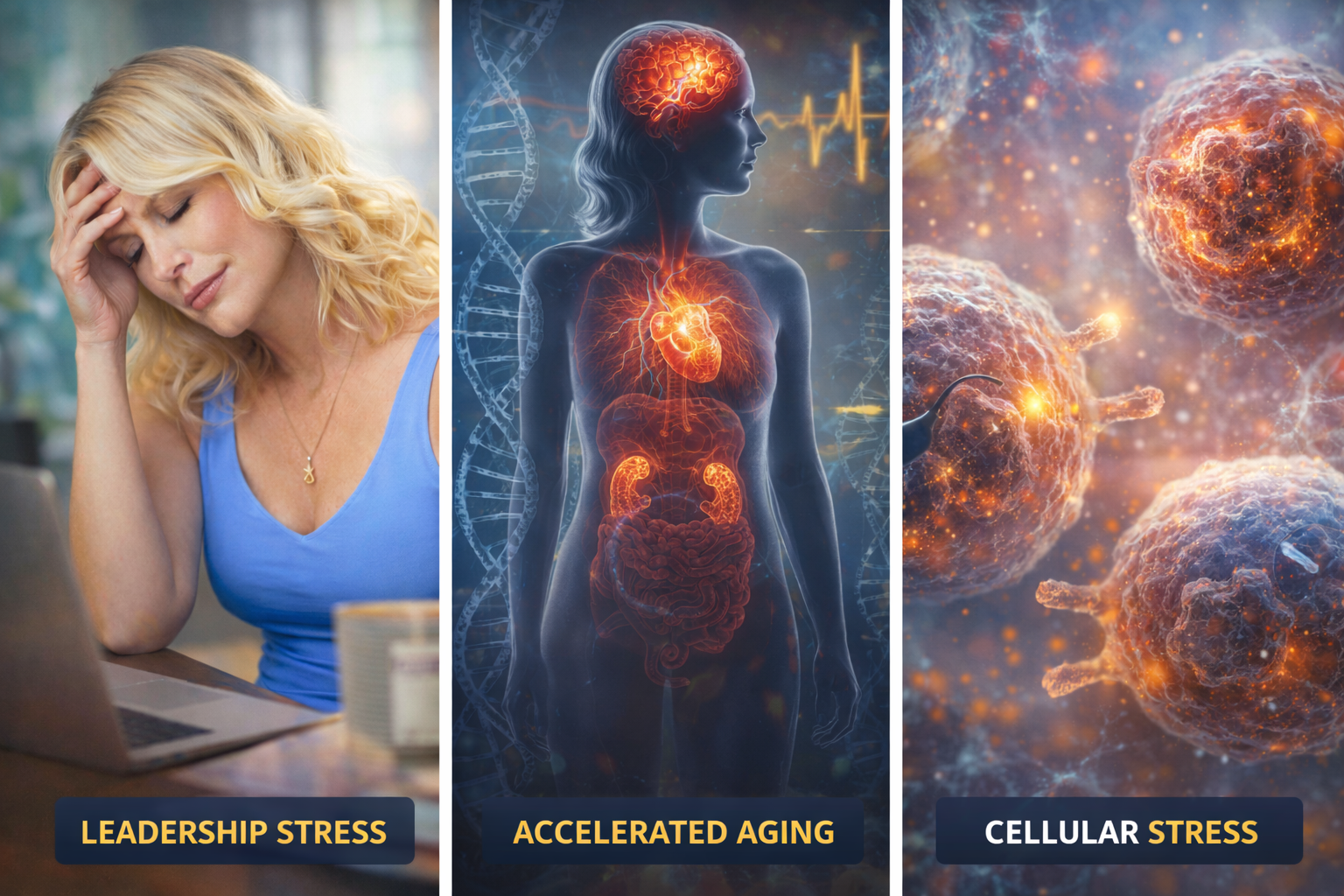
You don’t age because of time—you age because of cellular stress.
The single biggest factor speeding up that stress? Cortisol.
What High Cortisol Does Over Time:
Breaks down collagen → wrinkles and skin thinning
Disrupts sleep → slower cellular repair
Increases fat storage → especially around the midsection
Impairs memory and cognition → affects decision-making
This isn’t about vanity. It’s about functional longevity. About staying mentally sharp and physically energized—well into your 40s, 50s, 60s, and beyond.
How to Regulate Your Nervous System as a Leader
You don’t need to quit your job or move to a cabin in the woods. You need small, strategic shifts that support your biological resilience.
Daily Regulation Tools:
Breathwork (3-5 minutes): Inhale for 4 counts, exhale for 8. Repeat.
Midday walks: Not for steps—for decompression.
Nervous system-aware breaks: No screens. Just stillness.
Time blocking for recovery: 10-15 minutes between meetings.
Body scans: Check in with your jaw, neck, shoulders—release tension.
These are real wellness tools for people who actually have full calendars and real responsibilities.
The Myth of Work-Life Balance for High Performers
Let’s be honest—balance is a myth for most leaders.
You’re not splitting your life into equal parts. You’re carrying simultaneous layers of responsibility. So instead of chasing balance, build rhythm.
Think Rhythm, Not Balance:
Can your week include both intensity and restoration?
Do you have systems in place to downshift, not just perform?
Is your recovery scheduled, or just a “someday” intention?
Balance suggests perfection. Rhythm builds sustainability.
Connection Is a Health Practice, Too
One of the most overlooked aspects of leadership wellness? Community.
Leadership is isolating. When you’re at the top, there are fewer safe places to be real. But human connection regulates the nervous system. It lowers cortisol, improves immune function, and even reduces all-cause mortality.
Build Connection Into Your Life:
Peer mastermind groups
Somatic coaching or therapy
Friends who see you beyond your role
Regular, unscheduled time with people who don’t want anything from you
This isn’t just emotional hygiene. It’s physical health insurance.
Key Takeaways
Leadership stress is a biological issue, not just an emotional one.
Chronic stress accelerates aging through elevated cortisol, inflammation, and poor sleep.
High-functioning people can still suffer from nervous system dysregulation.
True wellness for leaders includes nervous system care, rest, boundaries, and connection.
Redefining success through sustainability leads to long-term health and impact.
